|
|||||||||||||||||||
|
| |||||||||||||||||||
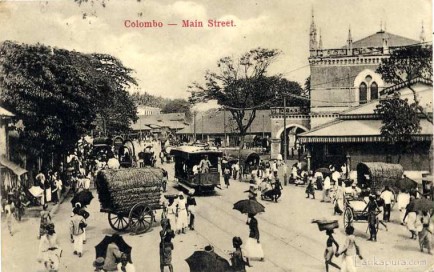
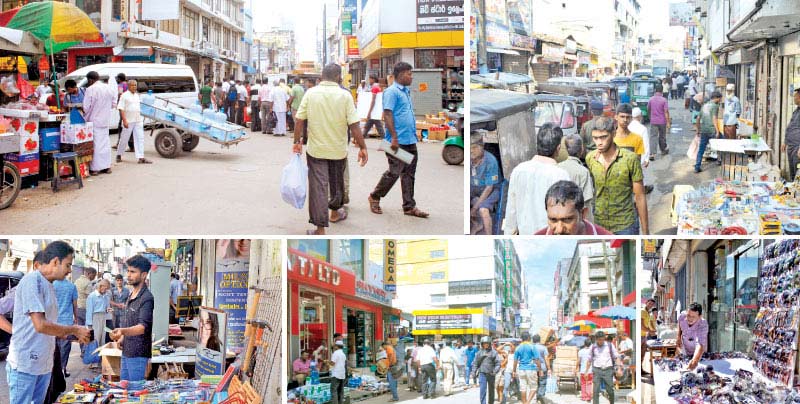
Colombo Pettah Commercial DistrictWhen one moves northwards from the Fort along Lotus Road, Prince Street or Galle Buck Road, one eventually enters the town of The Pettah, the bazaar town of Colombo. The Pettah begins where Colombo Fort ends and spreads it tentacles across towards Kotahena in the North and legal district of Hultsdorf to the South. It is a small town similar to The Fort and is more like a bazaar catering to many wholesale businesses. In the old days the retail business thrived in the Pettah too but today many of them have moved away to other lucrative locations within the city and some even out of the city towards the Nugegoda and Dehiwela areas.
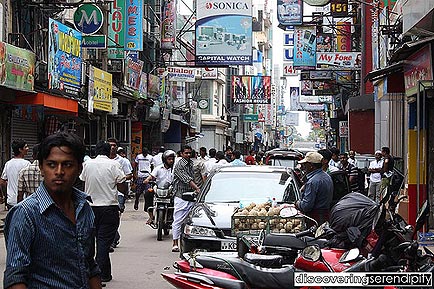
The main thoroughfares in Pettah are Main Street that cuts the town into two, Reclamation Road, now renamed to NHM Abdul Cader Mawatha, bordering the sea, Bankshall Street parallel to it, and Norris Road, now called Olcott Mawatha. McCalum Road, also borders the Pettah and moves towards Maradana. It is now referred to as D R Wijewardena Mawatha after the famous lake House newspaper tycoon. The streets that cross Main Street are Front Street, 1st Cross Street, 2nd Cross Street, 3rd Cross Street, 4th Cross Street & 5th Cross Street. Keyzer Street, Prince Street, & maliban Street run parallel to Main Street towards Olcott Mawatha. Bodhiraja Mawatha connects Olcott Mawatha to Main Street and meets it at the junction of Sea Street and Gabo's Lane. Immediately east of Fort (across the narrow canal that separates the outer harbour from the Beira Lake) is Pettah, a maze of streets and alleys piled and crammed with goods of every description, from colourful textiles, gold and silver, and colonial-era antiquities to the necessities of everyday life - spices, fruit and vegetables, reeking heaps of dried fish, paraffin, batteries, electrical goods, clothes and footwear. Whatever you are looking for, you'll find it in Pettah - though shopping here, which can call for determined bargaining, is not for the faint of heart. Among the most interesting streets for both sightseeing and shopping is Sea Street, in the northeast corner of Pettah, with its goldsmiths' workshops and the dramatically colourful Hindu Kathiresan and Old, Kathiresan kovils (temples). These are the starting point for the Vel festival, celebrating the marriage of the god Murugan (the top Tamil deity) to his queen. Deivanai and concubine Valli Ammal, and held each year in August. Not too far from these stand the Grand Mosque, the most important mosque for Sri Lanka's Muslim population, on New Moor Street, whose very name reflects a long-standing heritage of contact with the Arab world, and the Jami Ul Alfar Mosque, at the corner of Bankshall Street and Second Cross Street. Built at the beginning of the 20th century, its decorative brick- work, patterned in red and white, is conspicuous. Pettah is one of the most vibrant and colorful parts of Colombo. In Sinhalese called Pitta-Kottuwa, literally translating to Outer Fort, Pettah is known for its bustling open air bazaars and markets. You name it and your will find it in Pettah, with each thoroughfare having its own specialty — Gabo’s Lane and 5th Cross St specialize in Ayurvedic medicines, while jewelery stores line 2nd Cross Street and Sea Street. If you end up on Prince Street, be sure to visit the Dutch Museum which was originally the 17th century residence of the Dutch Governor. Pettah is also of the most ethnically mixed parts of the city and the streets are dotted with several interesting Mosques, Hindu Kovils, Churches and Buddhist Temples. The beautiful, red and white candy-striped, Jami-Ul-Alfar Mosque is a popular tourist destination and provided me some wonderful photographs.
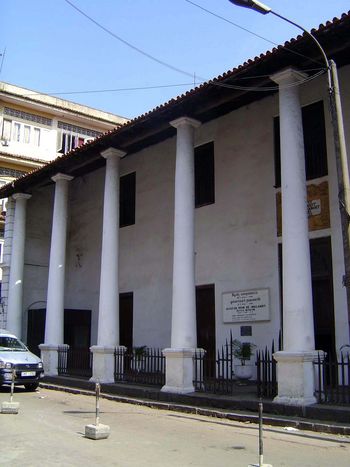
The Dutch MuseumThe old 'Dutch House' on Prince Street, Pettah (Colombo-11) which houses this museum was built in the latter part of the 17th century and was initially the residence of Count August Carl Van Ranzow along with five other houses of the elite. Today, the sides of the street are choc-a-block with boutiques and stores of moslem traders. The restoration of this building commenced in 1977 and was completed in 1981. This museum was opened to the public in 1982. This building embodies the unique architectural features of a colonial Dutch town house. The museum while displaying the Dutch legacy with the artefacts viz. furniture, ceramics, coins, arms etc. portrays facets of contemporary life and culture. Open daily except Fridays from 0900 Hrs. to 1700 hrs. The old 'Dutch House' in Prince Street, Pettah, which houses this museum was built in the latter part of the 17th century. It was the residence of Count August Carl Van Ranzow. Today, the sides of the streets are filled with boutiques and stores of traders. The building embodies the unique architectural features of a colonial Dutch town house. The museum which displays the Dutch legacy with artefact - viz. furniture, ceramics, coins, arms, etc. - portrays facets of contemporary life and culture. Fort & Pettah are generally safe during the day. However general safety tips apply — travel with a friend (specially women) and be vigilant of pickpockets. Parts of Fort are closed off to the public due to several government offices in the vicinity, be sure to carry your passport or National ID Card (NIC). Unwinding Pettah streets: A hard bargain?
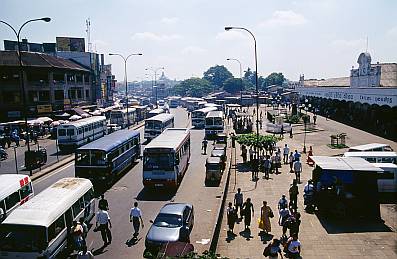
by Kathya de Silva - Senarath: The Daily News of 2 December 2015A solution to the chaos at Pettah and removal of pavement hawkers had been an issue for debate for several years. Past governments tried to relocate pavement hawkers and build new areas for them, but such plans were not without faults. Until today, traders have been unable to agree on the allocation of stalls, while the Floating Market had been unable to attract crowds as expected. The by-roads of Pettah are completely occupied while the roads are dilapidated, making it difficult for people, let alone vehicles, to pass. Trading is carried out in a disorderly manner while police raids on illegal businesses and sale of smuggled items are common occurrences. Although consumers hope for better pavements and shopping facilities in Pettah, streamlining the chaos had been a hard bargain for many years due to several reasons. Many trade associations have called for a better system to order the disorder, but it had been difficult for the government to implement it. Traders on the streets of Pettah are growing in numbers. The need for convenient locations for trading had been a call of consumers as well as traders themselves, even though better prospects for traders are viewed with suspicion by some. However, the government has assured that solutions would be provided soon to Pettah – its traders and consumers, which would be agreeable to all parties. For consumers, it is a matter of taking a tiresome journey under the hot sun but being rewarded with gems in the rubble for just half rate. The streets of Pettah may be hard to manoeuvre, but it is a place of diversity where anything can be found if one knows where to look. “The past government in 2010 prohibited vendors from carrying out their sales on streets. This ban was in effect countrywide. Agreeing to our request, Pettah pavement hawkers were provided with a trading complex at Bodhiraja Mawatha. At present, 534 traders are carrying out their businesses while another 467 have been unable to agree on the allocation of stalls,” said Federation of Self-Employed Persons Vice President M. K. Joseph Anthony. He added that problems were encountered when mobile traders were moved away from the main streets. The last government provided mobile traders with mini lorries, but they had parking issues and business was slow as vehicles were only allowed to park where less crowds gathered. Later, street vendors were allowed to trade on by-roads instead of the main roads which was a relief for many traders of Pettah. But this was not in effect in other urban areas such as Kandy, Galle, Kataragama etc, Anthony pointed out. Anthony agrees that trading on Pettah streets needs to stop. He requests the government to provide pavement hawkers with a proper place to trade in dignity. “Traders have to fight for a good place on the streets. One day they would be trading at one location and the next day, they would relocate as someone else had taken their place. It is very chaotic especially for mobile traders,” Anthony stressed. Patriotic National Pavement Traders’ Association and Three-Wheeler Drivers’ Association Chairman Ven. Uvatenne Sumana Thera had also been vocal for many years on providing better spaces for pavement traders. “Most traders at Pettah have been there for almost 60 years. Some traders have their own places, but others don’t have a place to trade,” the Thera said. “It is not a methodical system. Traders carry out their businesses in a chaotic environment. There is no proper system,” he added. The Thera said, as the chief incumbent of Bodhirajaramaya, Maligawatte, he came forward to give a voice to the woes of pavement hawkers. “They are self-employed and do not expect anything from the government. Such people need a proper place to do their businesses in peace. Every government promised various things but nothing significant came out so far. Although the previous governments tried to implement a proper system, it was not a comprehensive approach. We have to take examples from places such as India, Malaysia and Singapore and implement a better system for small scale traders on streets,” the Thera added. Although relocating pavement hawkers had been in the offing for many years, some traders are a little apprehensive. They fear that they will lose their businesses and do not want change. Although a chaotic place like Pettah is hard to re-organize, it is a necessary task which has to be done with the consensus of all parties. “A place like the Floating Market has not been planned properly. It is located away from crowds and there are only two access points to it. The railings are dangerous and it is difficult to take children there. The people want to grab something quickly while waiting for a bus and move on. They wouldn’t take the trouble to go to the Floating Market to do that,” Federation of Self-Employed Persons Vice President M. K. Joseph Anthony said. Ven. Uvatenne Sumana Thera pointed out that a new location should avoid all these mistakes. A comprehensive plan should be in place where both consumers and traders benefit. “Wherever a new complex is located, there should be areas where restaurants and refreshments stalls are located. The authorities must think of ways to draw crowds. Simply setting up a building and re-locating traders will not do,” the Thera said. In a place like Pettah where smuggled goods are rampant and counterfeit international consumer items are available for half rate, the ability to streamline and organize Pettah businesses is a big question. Ven. Sumana Thera, however, says that is up to the law enforcement authorities. “The police and law makers are there to investigate into illegal trading. The government has to enforce proper strategies to bring culprits to book. A method must be introduced to standardize consumer goods. Health authorities must ensure food hygiene,” he said. The Thera added that halting the re-organisation of Pettah considering the plight of illegal traders is ridiculous. The government has the responsibility of stopping illegal trading, he pointed out. The Ministry of Megapolis and Western Development is at present drawing up plans to provide better trading conditions for Pettah pavement hawkers. “We discourage traders from carrying out their businesses on pavements. Pavements are for pedestrians. The ministry is drawing up plans to re-locate pavement traders by providing them with better locations without disrupting their livelihoods,” said Minister of Megapolis and Western Development Patali Champika Ranawaka. “Discussions are underway with relevant stakeholders on systematic restructuring of city areas. We plan to make Fort the transport hub of the province. The bus stand and railway station will be brought to one location. There will be a special road to connect the port and the airport. With such changes, Colombo, especially Fort will have a facelift,” the minister said. The changes to Fort and Pettah would redirect crowds, making it possible for authorities to redesign new locations for traders. Even though the Budget does not include redesigning plans for Pettah or pavement traders, discussions are underway, Minister Ranawaka added. He said the Floating Market was designed on aesthetic value instead of taking the needs of consumers into account. It is a failure as it does not draw crowds. The new plans would correct the faults of the past government and provide solutions to benefit both the consumer and trader, the minister stressed. A restructured Pettah and orderly trading activities would indeed be a sight to look forward to. Although it may seem a distant dream, ordering the chaos of Pettah and giving it a facelift is an ambitious project of the government. Trader associations' call for dignity and convenience for small-scale self-employed persons such as pavement traders, need be addressed sooner than later. However, the burning question is whether it would be possible for the government to please everyone. Paid stall rental for 5 years “I have two sons. My wife does not work. My family depends on me for sustenance. At present, I have no problems with my daily income. Consumers buy my wares. But I will be happy to move to a better place rather than stand in the hot sun every day,” Rajendra said. Tempting variety “I come to Pettah because of the reasonable prices and there is a range of products that we can choose from. You would not see such variety in other places,” she said. She admits that moving through Pettah streets is difficult, but says it is worth it. “I came to buy cards. But I bought other things that caught my eye,” Priyadari said, adding that the diversity of goods usually tempt her. Standing for hours She carries her goods and stands on the pavement from 9.30 am to about 3 pm. “I don’t have a place to sit. I don’t have any other choice but stand and sell my wares. By afternoon, I am unable to keep standing anymore. So I go home at that time,” Siriyawathie said. When the police removed pavement hawkers on main streets, Siriyawathie had to come to 2nd Cross Street. “The police can’t remove me as I am selling my wares while standing. I would like to have a permanent place for trading,” she said. "The Federation of Self-Employed allocated a stall for me and I even paid them. But I never got a stall," she said. Walking through Pettah a Treat “There is freedom to choose at Pettah. The price is good," he added. "I travel all the way from Hatton to come here because I like Pettah,” he said. Fowzie added that there is a culture in Pettah that he would miss if traders are shifted to a new location. He said he likes the way things are at Pettah. “For many years and decades, people are used to 1st Cross Street, 2nd Cross Street etc. "I am happy to wonder around on these streets as I discover rare items for very low prices. Walking on these streets is not difficult if you get used to it. I like walking on these lively streets,” he said. New places need crowds “I have two sons and a daughter. My wife does not work,” he said. “I actually think that the spot where I do my business is better than a stall located elsewhere. Crowds gather here. People may not come to Pettah to buy my wares. But when they come for other things, they see that I sell something interesting and people stop to buy it,” Imitiyaz pointed out. He added that if a permanent, well-organised location is given for pavement traders, the authorities must allocate stalls for a lot of traders. Only then will people come to the new place. They would even like to wonder around and stop to buy something that they did not even intend on buying. ‘Stop harassing women’ “I come to Pettah twice a month. I travel by bus or train and get off here. It is easy for me to step into Pettah, look around and take another bus,” she said. Athukorala said sometimes it is difficult for young girls to go to Pettah alone. “Girls could be harassed. If there is a better place for pavement traders, I’m sure this would lessen,” she said. “When I walk around, I see interesting items. I like to walk on the streets as there is a lot of variety. You may never know what you will find. It is however, difficult to walk on dilapidated roads in the dirt. Some shopkeepers throw their waste on to the streets, which becomes difficult for shoppers. Other than that, pavement hawkers don’t bother me,” she added. creatively Self-employed “I have been on Pettah streets for about 12 years. This is what I sold during all these years. I have a machine at home where I manufacture the plastic fish. My family helps me,” he said. Gunatilake stands from 10 am to 4.30 pm on 2nd Cross Street selling his wares. He does not have a place to sit or set up a table. “I was promised a stall on Malwatta Road but I never got it. Where ever authorities establish stalls, it should be a place where crowds gather. Otherwise, it will affect our business,” he said. “I have been able to carry out the same business because I was creative. This is my own product,” Gunatilake said proudly displaying his plastic fish. “Children like this as it is colourful and it is an activity for them. I work hard and it is paying off,” he said. Courtesy: The Daily News of 2 December 2015
|